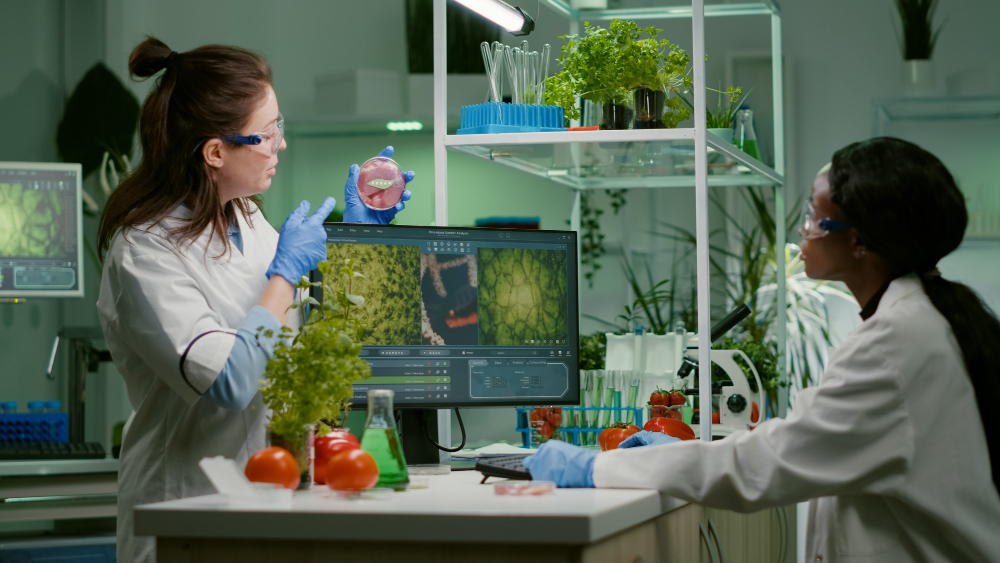







How Artificial Intelligence and Big Data Are Transforming Science in 2025
In 2025, Artificial Intelligence (AI) and Big Data have become the twin engines driving the next era of scientific discovery. From decoding the mysteries of the human brain to accelerating climate research and drug development, these technologies are redefining how scientists think, analyze, and innovate.
The integration of AI and data analytics has not only made research faster — it has made it smarter, more predictive, and more accurate. Let’s explore how these transformative technologies are reshaping science across every field.
🤖 1. AI and Big Data: A Perfect Partnership in Modern Science
AI refers to machines and algorithms capable of learning, reasoning, and problem-solving, while Big Data represents the enormous sets of structured and unstructured information generated daily.
Together, they enable researchers to:
- Analyze massive datasets in real time.
- Identify patterns and correlations humans could easily miss.
- Predict future trends and outcomes with high accuracy.
In 2025, this powerful combination has become a core pillar of scientific research, bridging the gap between theory and application.
🧬 2. Revolutionizing Healthcare and Genomics
AI and Big Data have completely transformed medicine and biotechnology. By processing trillions of genetic sequences, AI models now detect diseases long before symptoms appear.
Key innovations in 2025:
- AI-powered diagnostics can identify cancers, heart diseases, and neurological disorders with near-perfect precision.
- Genomic sequencing powered by Big Data helps doctors customize treatments for each patient — ushering in the age of precision medicine.
- AI algorithms accelerate drug discovery, predicting molecule interactions in days instead of years.
This integration of AI and data analytics is saving lives and redefining how healthcare systems operate.
🔬 3. Accelerating Scientific Research and Discovery
In the past, scientific research was limited by the speed of human analysis. In 2025, AI-driven systems can analyze experimental results, generate hypotheses, and even design new experiments autonomously.
Examples include:
- AI “scientists” that predict material properties for new sustainable technologies.
- Big Data simulations for climate modeling, allowing more accurate predictions of environmental changes.
- Automated lab robotics controlled by AI for faster and safer research.
This new paradigm has made research 10x faster and more cost-effective than traditional methods.
🌍 4. Climate Science and Environmental Protection
AI and Big Data are at the forefront of the global fight against climate change.
In 2025, scientists use AI to:
- Track deforestation, ocean health, and pollution levels in real time.
- Predict natural disasters like hurricanes or droughts with unprecedented accuracy.
- Optimize renewable energy grids and reduce carbon footprints using intelligent systems.
By analyzing satellite imagery and sensor data, AI is helping scientists make smarter, data-driven environmental decisions that protect our planet.
🧠 5. Neuroscience and Brain Mapping
The human brain remains one of science’s greatest mysteries — but AI is unlocking its secrets faster than ever.
Using Big Data neural mapping, scientists in 2025 have built digital replicas of brain activity to study memory, learning, and emotions.
Applications include:
- Developing treatments for Alzheimer’s, Parkinson’s, and depression.
- Understanding how consciousness emerges from neural networks.
- Creating AI models inspired by human cognition for more advanced computing.
This convergence of AI and neuroscience is bringing us closer to understanding what it truly means to be human.
💰 6. Transforming Economics and Social Sciences
AI and Big Data aren’t limited to physical sciences — they’re revolutionizing social research, too.
In 2025:
- Economists use predictive analytics to forecast market trends and inflation.
- Sociologists analyze massive datasets from social media to understand human behavior and cultural shifts.
- Governments employ AI to design data-driven policies that improve public health, education, and urban planning.
This data-centric approach makes social science more quantifiable, objective, and actionable than ever before.
🚀 7. Space Science and Astronomy
The universe generates more data than any supercomputer can process — but AI has changed that.
In 2025, space agencies like NASA, ESA, and SpaceX use AI and Big Data to:
- Identify new exoplanets and potential habitable worlds.
- Analyze cosmic radiation, black holes, and gravitational waves.
- Optimize space missions using real-time data analysis from satellites.
These tools are helping humanity explore the cosmos faster, cheaper, and more intelligently.
🔐 8. Data Security and Ethical Challenges
As AI and Big Data grow, so do ethical and security concerns. Scientists must address:
- Data privacy and ownership issues.
- Algorithmic bias that could skew scientific results.
- Ensuring transparency in AI decision-making.
The scientific community is now adopting ethical AI frameworks to ensure innovation remains trustworthy, fair, and beneficial to all.
🧩 9. The Rise of Autonomous Research Systems
By 2025, “self-driving labs” — AI-managed systems that conduct experiments independently — have become a reality.
These labs:
- Design, test, and refine hypotheses automatically.
- Learn from previous experiments to optimize new ones.
- Reduce human error while speeding up discovery cycles.
This autonomy allows scientists to focus more on creative thinking and interpretation while machines handle the repetitive, data-heavy work.
🌟 10. The Future: Data-Driven Science and Beyond
Looking ahead, AI and Big Data will continue to redefine every aspect of research. Scientists are moving from data collection to data prediction, using intelligent models that foresee outcomes and generate solutions proactively.
The next frontier includes:
- Quantum-AI integration for ultra-fast computation.
- Real-time data sharing across global research networks.
- Digital twins of ecosystems, organs, and cities for simulation and optimization.
Science is no longer confined to laboratories — it’s becoming a dynamic, data-powered ecosystem that evolves alongside human curiosity.
💡 Final Thoughts
AI and Big Data are not just tools — they are the new scientific method. They’re transforming how we observe the universe, how we heal ourselves, and how we plan for the future.
As 2025 unfolds, one thing is certain: the fusion of intelligence and information will continue to accelerate discovery, making the impossible possible and shaping a smarter, more connected world.