






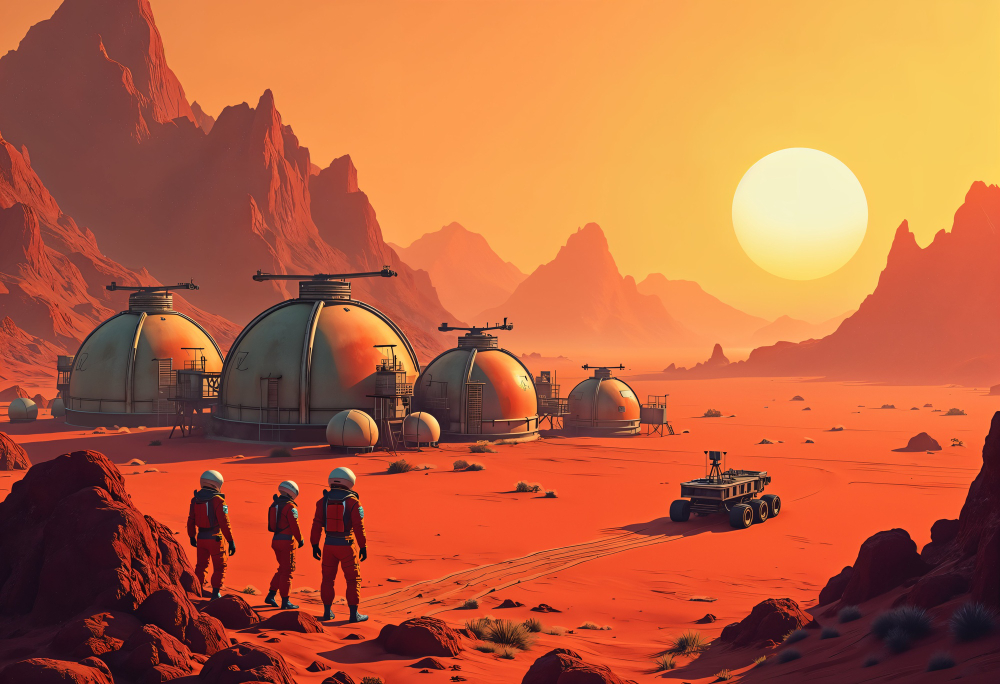
Space Exploration 2025: NASA, SpaceX, and the New Race to Mars
The dream of reaching Mars — humanity’s next great frontier — is closer than ever before. In 2025, space exploration has entered a thrilling new era led by NASA, SpaceX, and a growing number of international and private space agencies. From lunar missions to interplanetary travel, the world is witnessing a renaissance in space innovation, collaboration, and ambition.
Let’s dive into how 2025 is shaping the new race to Mars and redefining humanity’s place among the stars.
🚀 1. A New Era of Space Exploration
After decades of gradual progress, space exploration is now accelerating at unprecedented speed. With reusable rockets, AI-driven satellites, and global partnerships, 2025 marks the transition from exploration to expansion.
Private companies like SpaceX, Blue Origin, and Virgin Galactic are working alongside national agencies such as NASA, ESA, and ISRO, fueling competition — and cooperation — in the quest to explore the cosmos.
🌕 2. NASA’s Artemis Program: Gateway to Mars
NASA’s Artemis program remains at the heart of space exploration. After the success of Artemis I and II, 2025 brings the ambitious Artemis III mission, aiming to land astronauts — including the first woman and person of color — on the Moon’s south pole.
Why it matters:
- Establishes a sustainable lunar base to test technologies for future Mars missions.
- Uses the Lunar Gateway, a space station orbiting the Moon, as a refueling and research hub.
- Develops life support and propulsion systems that will later power crewed Mars expeditions.
The Moon, once a destination, is now becoming a launchpad to Mars.
🛰️ 3. SpaceX: The Private Pioneer of Mars Colonization
No company has captured the imagination of space enthusiasts quite like SpaceX. Under Elon Musk’s vision, SpaceX is determined to make humans a multi-planetary species.
Key Developments in 2025:
- Starship rockets are performing successful cargo and crewed test flights in preparation for Mars transport.
- SpaceX’s collaboration with NASA supports cargo missions to the lunar Gateway.
- The company is testing in-situ resource utilization (ISRU) — creating fuel and oxygen from Martian resources.
Musk’s ultimate goal? To establish a self-sustaining colony on Mars by the 2030s — and 2025 is a pivotal step toward that dream.
🌍 4. Global Players Join the Race
The new space race isn’t limited to the U.S. In 2025, countries across the globe are contributing to space exploration in remarkable ways:
- China’s CNSA is advancing its Tiangong Space Station and planning a Mars sample return mission.
- India’s ISRO follows up its successful Chandrayaan and Mangalyaan missions with new lunar and Martian explorations.
- Europe’s ESA is developing new robotic explorers and partnering with NASA for deep-space research.
- Japan’s JAXA is leading asteroid exploration and lunar rover projects.
This global collaboration represents a shared human ambition — to reach beyond Earth together.
🔬 5. Technology Powering the New Space Age
The 2025 space race is as much about innovation as it is about exploration. Modern missions rely on technologies that make space travel faster, safer, and more efficient:
- Reusable rockets reduce costs and turnaround times.
- AI and robotics enable autonomous navigation and data collection.
- 3D printing supports the creation of habitats and tools in space.
- Nuclear propulsion systems promise faster travel to Mars.
- Quantum communication ensures secure and instant data transfer across vast distances.
These breakthroughs are not just expanding our reach — they’re redefining what’s possible.
👩🚀 6. The Human Side of Space Travel
As technology advances, the biggest challenge remains human survival in deep space.
NASA and SpaceX are researching how astronauts can endure long-duration missions:
- Radiation protection through advanced shielding.
- Mental health programs to combat isolation and stress.
- Sustainable food systems using hydroponics and bioreactors.
- AI medical assistants for remote diagnosis and treatment.
Every test and mission in 2025 brings us one step closer to safely sending humans to Mars — and bringing them back.
🪐 7. Mars Missions: The Countdown Begins
The excitement around Mars is building fast. Robotic missions are paving the way for human explorers:
- NASA’s Perseverance Rover continues to collect rock samples for future retrieval.
- The Mars Sample Return (MSR) mission aims to bring these samples back to Earth for study.
- SpaceX Starship tests simulate Mars entry, descent, and landing procedures.
By the end of 2025, the groundwork for the first crewed Mars mission in the 2030s will be stronger than ever.
🌌 8. The Future of Humanity in Space
Space exploration is no longer about competition — it’s about coexistence and survival. With climate challenges on Earth, space offers new opportunities for research, resources, and possibly even refuge.
Space tourism is also growing rapidly, allowing civilians to experience microgravity and view Earth from orbit. What was once science fiction is now an emerging industry.
The next decade will determine how far humanity can truly go — and 2025 is the year that sets the stage.
🌟 Final Thoughts
From NASA’s Artemis missions to SpaceX’s interplanetary ambitions, 2025 marks the dawn of a new space age. The race to Mars is not just a race between nations or companies — it’s a race for humanity’s future.
As rockets launch, rovers explore, and scientists innovate, one truth becomes clear: Our destiny is written in the stars — and we’re finally reaching out to touch them.